
Why Demonising Dog Food Brands Misses the Point


Ingredient Lists, Nutrition Myths and the Cost of Oversimplification
Dog food has become one of the most polarised conversations in the dog world. Certain brands are routinely dismissed as poor quality based on ingredient lists, while others are elevated through language such as natural, premium, or vet approved. What is often lost in the noise is evidence, context, and the simple reality that dogs are individuals.
Nutrition is not ideology. It is applied biology. The question is not which food sounds best to us, but which food has evidence behind it, what testing it has undergone, and how the individual dog in front of us responds.
Why ingredient lists are not a measure of dog food quality
One of the most common claims made online is that foods produced by large, research-led companies are inferior because the first few ingredients are not an easily recognisable whole protein. This interpretation misunderstands how pet food is formulated and regulated.
Ingredients are listed by weight before processing, not by nutritional contribution. Fresh meats contain a high proportion of water, which inflates their position on the label. Ingredients such as meat meals or hydrolysed proteins may appear less appealing to a human reader, but can provide consistent, highly digestible amino acid profiles once processed. A food does not nourish a dog because it looks good on the label. It nourishes a dog because it delivers the required nutrients in the correct balance and remains digestible, stable, and safe over time (FEDIAF, 2023).
Focusing on ingredient lists alone ignores formulation, nutrient bioavailability, digestibility, and quality control. These factors matter far more to the dog than whether an ingredient name sounds familiar.
What makes research-led diets different
Veterinary and research-led diets are formulated by teams that include animal nutrition scientists, food technologists, and veterinarians working within established nutritional and safety frameworks. These diets are subject to feeding trials, digestibility testing, shelf-life evaluation, and ongoing quality control.

This is why such diets are used clinically for gastrointestinal disease, allergies, renal disease, and other medical conditions. They are not perfect, and they are not right for every dog, but they have been through regulatory and scientific processes that many marketing-led foods have not.
By contrast, phrases such as vet-approved often mean very little. In many cases, this simply indicates that a single veterinarian has agreed to be associated with a product. It does not mean the food has undergone clinical trials. It does not mean long-term outcomes have been evaluated. It does not mean the food is appropriate for dogs with specific medical or digestive needs.
Dismissing research-backed diets while elevating untested alternatives because they sound better is not evidence-led decision making.
There is no one-size-fits-all in nutrition
One of the most damaging myths in dog nutrition is the idea that there is a single best way to feed dogs. There is not.
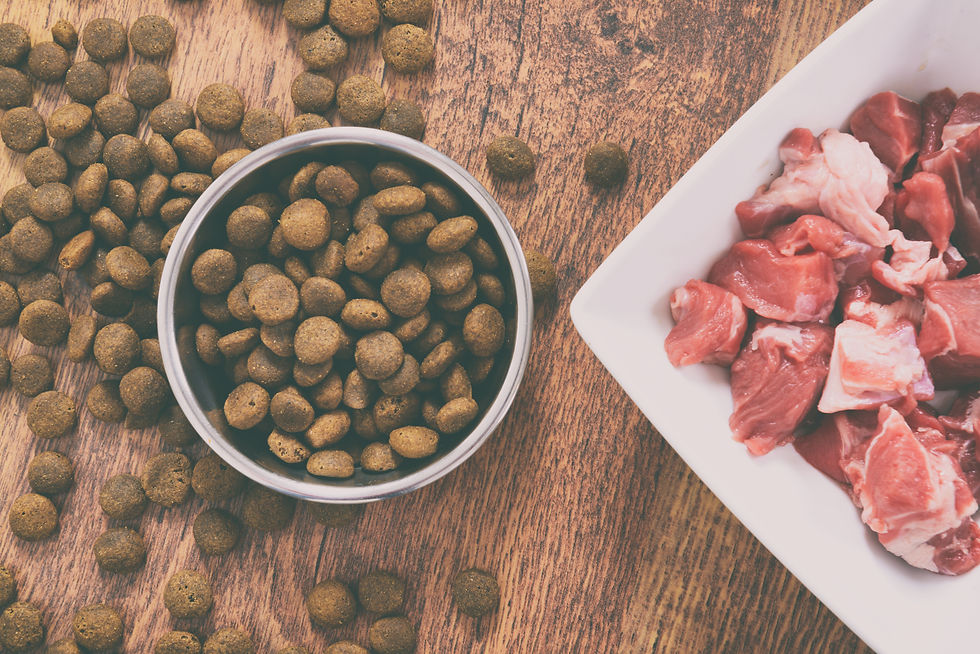
Dogs vary enormously in digestive tolerance, immune response, metabolism, and health needs. Even within the same litter, individual dogs may thrive on very different diets. One may do well on a raw or fresh diet. Another may develop chronic gastrointestinal upset. One may require a hydrolysed protein diet to manage allergies. Another may cope perfectly well on a standard commercial kibble.
This is not a raw versus kibble debate, or fresh versus wet. It is a suitability debate. What matters is what suits the individual dog, not what aligns with trends, belief systems, or online consensus.
Why algorithms and rankings fall short
Increasingly, owners are directed to online scoring systems that rank foods based on ingredient lists or perceived naturalness. These tools do not assess the individual dog. They do not account for health history, growth stage, digestive sensitivity, or medical need. They also do not evaluate whether a food has undergone feeding trials or regulatory scrutiny.
Nutrition decisions should be guided by evidence, observation, and professional input where appropriate. Coat quality, stool consistency, appetite, weight stability, energy levels, and behaviour provide far more meaningful feedback than a numerical score generated by an algorithm.
Nutrition also interacts with behaviour and wellbeing. Diet influences gut health, immune function, and stress physiology, all of which can affect behaviour and coping capacity (Pérez-Camargo and Butterwick, 2021). Repeated diet changes in pursuit of a perfect label can increase gastrointestinal upset and stress, particularly in sensitive dogs (Morelli et al., 2022).
Stability matters. Evidence matters. Individual response matters.
Why trainers need to tread carefully
As trainers and behaviour professionals, we have a responsibility to exercise caution when providing nutrition advice. Blanket statements that label certain brands as rubbish or promote others as superior without evidence can undermine welfare, particularly for dogs with medical or digestive vulnerabilities.
Very few people specialise in canine nutrition in the UK and Europe, and there is no direct equivalent to the American board certification system. This makes it even more important to rely on established regulatory frameworks, published research, and collaboration with veterinary professionals rather than marketing claims or online consensus.
Confidence should always be proportional to expertise.
What can owners do instead?
Look beyond ingredient lists and ask what evidence supports the food. Has it undergone feeding trials? Is it formulated in accordance with recognised nutritional guidelines? Is it used clinically?
Observe the individual dog rather than following ideology. Digestive health, coat quality, weight stability, and behaviour matter more than trends.
Consult your veterinarian when there are health or digestive concerns, particularly for puppies, adolescents, and dogs with medical conditions.
Be wary of absolute claims. If a food is presented as perfect for all dogs, that is a red flag.
Avoid frequent diet changes unless there is a clear reason. Stability supports both digestive and emotional well-being.
There is no moral hierarchy in dog food. There is only evidence, suitability, and the dog in front of you. When we centre the dog rather than the narrative, better decisions follow.
If you are a professional navigating complex conversations around health, behaviour, and wellbeing without wanting to default to trends or certainty, mentoring offers a space to think critically and work ethically without simplifying the science. If you are interested in how digestion, physical comfort, and movement intersect with behaviour, The Way They Move explores how the body often explains what behaviour alone cannot.
Acknowledgement
With thanks to Dr Jacqueline Boyd for her time and for offering general feedback on an early draft. This article reflects my interpretation of the evidence, and any inaccuracies are mine alone.
References
Boyd, J. (2023) Canine Nutrition: Food Feeding and Function. The Crowood Press Ltd
Case, L.P. (2019) Dog Food Logic: Making Smart Decisions for Your Dog in an Age of Too Many Choices. Chicago, IL: Dogwise Publishing.
FEDIAF (2023) FEDIAF Nutritional Guidelines for Complete and Complementary Pet Food for Cats and Dogs. Brussels: European Pet Food Industry Federation. Available at: https://europeanpetfood.org/self-regulation/nutritional-guidelines/ (Accessed: 13 December 2025).
Morelli, G., De Marcante, M.C., Zaghini, A. and Caldin, M.B. (2022) ‘Raw meat-based diets for dogs: A review’, Animals, 12(16), 2030. Available at: https://www.ncbi.nlm.nih.gov/pmc/articles/PMC9379419/ (Accessed: 13 December 2025).
Pérez-Camargo, G. and Butterwick, R. (2021) ‘Diet and behaviour in dogs: A scoping review on the impact of nutrition on canine behaviour’, Appetite, 159, 105113. Available at: https://www.sciencedirect.com/science/article/pii/S0195561621000164 (Accessed: 13 December 2025).


Comments